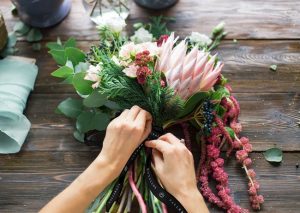
Ikebana (ike – life, bana – flower) came to Europe from Japan. The art of creating decorative arrangements from cut flowers, shoots, and branches in special vessels has a deep religious and philosophical meaning in its homeland. Live floral compositions can quickly and easily decorate an interior, adding an elegant oriental flair to your home.

We have curated a selection of free lessons on the theory and practice of ikebana art for beginners. This article provides a comprehensive course of the best educational videos for self-study at home.
The Basics of Ikebana Art
https://youtube.com/watch?v=z2wvqpQUeKA
European floristry is akin to painting: it creates form, color, and a storyline. The Japanese technique is closer to architecture: it is built according to strict structural schemes, where each element is placed in a specific plane and at a precise angle. The allegorical basis of the design – shin (heaven), soe (man), and hikae (earth) – serves as the essential framework for the creative process.
Classical Styles
Ikebana originated in Buddhist monasteries as a decoration for rituals and spiritual services. Strictly vertical tatebana were placed next to the statue of Buddha as a symbol of the transience and beauty of life. Lush, pompous bouquets symbolized the greatness of nature and were called rikka (standing flowers). Nageire features more modest bouquets with a free-flowing arrangement of components. Minimalist chabana traditionally accompanied tea ceremonies. Shoka is a three-color bouquet symbolizing the harmony of the world, while moribana represents a miniature landscape.
What You Will Need
First and foremost, you need to select floral materials in accordance with your concept: dry or living plants, wildflowers, greenery, and tree branches. Secondly, you need a vessel – keep it simple, transparent, or solid-colored, without excessive gloss, heavy decor, or shine (vases of various shapes, shallow plates, glasses, or goblets work perfectly). As a platform for installing and fixing the stems, a kenzan is used – a heavy device with brass needles on a lead or metal base. Additional tools include a tape measure or ruler, floral pruners, or sharp scissors.
Workflow and Arrangement Rules
A classical composition typically has a right-sided direction. For a harmonious ensemble, add the width of the vase to its height, then multiply by 1.5 to calculate the required length of the main branch. The secondary branch is shortened by a third relative to the main one. The kenzan is lowered into the vase and covered with water to nourish the plants. The central branches are installed first, followed by the main flowers, and finally – a delicate undergrowth of small branches or foliage.
Ikebana in a Shallow Vessel
The moribana style is a composition designed in a flat or shallow vase. The roots of this idea go back to ancient tea ceremonies when buds were set afloat on water in beautiful vessels to create the right mood and aesthetics. Flowers and leaves are directed towards the viewer and upwards, towards the sun. The elements are arranged asymmetrically. Shin, soe, and hikae form a tilted triangle (an intermediate position between vertical and horizontal) – a technique that creates dynamic movement, a feeling of naturalness, and mobility.
Ikebana in a Tall Vase
For this project, you will need: a sufficiently long branch of medium thickness with leaves, four large flowers with long thick stems, and a tall vessel with a wide neck. A cross made of twigs is installed as a supporting base in the upper part of the vase. The length of the shin is determined by the formula: the height of the vessel + two diameters + half of the resulting length. The height of each subsequent element is determined by the previous one. The first flower will be ¾ the height of the main branch, the second – ½ of the main one, the third – ½ of the second, and the last – slightly longer than the previous one.
Autumn Ikebana
In many latitudes, autumn and winter arrangements made of dry branches, deadwood, bunches of rowan berries, and fallen leaves are especially popular. Often, artificial materials are added as decor: small beads, styrofoam, or cotton wool to simulate snow. Dried mushrooms and fragments of natural tree stumps also look incredibly harmonious in autumn compositions.
Spring Ensemble in a Modern Style
Using just a few branches of a flowering tree and spring primroses, you can create simple yet very bright masterpieces with a wonderful aroma capable of filling a room. This tutorial video provides a scheme for making an arrangement from pear branches and lungwort in the style of the Sogetsu school. This technique emerged in the 1920s and is considered a modern, avant-garde direction of ikebana.
Peony Sphere
https://youtube.com/watch?v=FDVQQfpU38c
Floral designs in the form of a sphere are made using a spherical floral foam sponge soaked in water (similar to what is used in traditional flower baskets). Ensembles complemented by long blades of grass or flexible branches shaped like peculiar springboards look highly interesting and conceptual. In these designs, flat substrates made of wood, plastic, or slate typically serve as the platform rather than traditional vessels.
Dried Flower Ikebana
Floral masterpieces made from dried flowers are a massive recent trend. With careful storage, these crafts can last practically forever. If desired, you can seamlessly combine them with live flora. You can forage and dry the materials yourself, or purchase them in specialized stores or from professional purveyors. If doing it yourself, you will need to familiarize yourself with the art of herbariums and learn how to safely dye the source materials in brighter tones.
Ikebana is a path of spiritual perfection and a practical design art form at the same time. Its primary goal is to highlight the beauty of nature and the natural charm of plants. Practicing this craft helps to release stress and negativity through a deep connection with something truly beautiful.