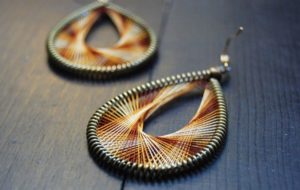
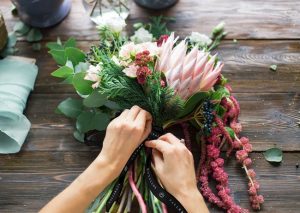
Weaving from thin wire and silk thread is an elegant type of needlework originating from the islands of Malta. The name of the craft comes from the Spanish word “canutillo” — a spiral wire made of gold or silver. The craft originally arose in medieval monasteries as a way to decorate altars and statues of saints with handmade flowers. Later, Europeans borrowed this beautiful art for home decor and jewelry making.

FreeHandmade.com has selected the best free Ganutell video tutorials that will introduce beginners to this exclusive weaving technique right at home and add to the inspiration board of experienced craftswomen.
DIY Ganutell Petals
To practice this elegant hobby, you will need a minimal tool set: two types of wire (thin/flexible and strong/thick) + threads of your favorite color and quality. A spiral is twisted from a thin wire rod, compacted with a rigid wire, and shaped into a petal. After that, a thread is secured on the resulting frame, and you begin to wrap each turn of the spring, creating a beautiful pattern. There are several ways to wind the embroidery floss. The simplest one is in the form of a figure-eight from top to bottom, where the lower edge is wrapped on the front side, and the upper edge on the back side, moving in a continuous circle.
Ganutell Orchid: Master Class
Floral compositions based on the Ganutell principle have many advantages over other types of crafts. Compared to beaded flowers, they are lighter and airier; compared to fabric ones, they are much stronger; and compared to real or dried flowers, they are incredibly durable. Unlike the familiar techniques listed, Ganutell looks more elite and self-sufficient. The technique is simple and accessible even to beginners far from needlework. You can create a beautiful piece on your first try, but professional and flawless results will require a bit of practice.
Assembling a Ganutell Rose
Whole plants are assembled from individual blanks. Petals and leaves can be of various shapes depending on the desired flower style: oval, square, triangular, round, or pointed. As a result, you can create realistic lilies, daisies, tulips, or pure fantasy inflorescences. The rose is the most aristocratic flower and is therefore very popular among Ganutell artisans.
Handmade Pendant
The history of pendants goes back to Ancient Rome when emperors rewarded distinguished associates and military leaders with heavy chest decorations in the shape of a huge gold coin. Medallions were made strictly from precious metals – gold, silver, and copper. In the Middle Ages, pendants contained relics of saints or locks of hair from loved ones, carrying a memorial character. During the Romantic era, memorable jewelry significantly lost its size but gained in decoration (engraving, inlay, painting, granulation). Nowadays, pendants have become the most popular type of jewelry, which can be effortlessly purchased in any price segment. But a medallion made by hand in this ancient technique has a truly special value.
3D Ganutell Flower
Ganutell is equally suitable for clumsy children’s fingers and the skillful hands of a master. The very first crafts are usually made flat and simple. Having got the hang of it, artisans sculpt life-size 3D flowers with realistic curves, creases, and carved contours. The crafts can be further decorated with beads, feathers, and sequins, weaving elements one after another into the general canvas. The results are luxurious, elegant, and totally unique creations.
Openwork Jewelry Set: Bracelet and Earrings
Artificial flowers have always been a success among decorators. Imitations of live bouquets and boutonnieres look incredibly advantageous in interior design, on clothing and accessories, as costume jewelry, souvenirs, and elements of gift wrapping. The craft is rightfully equated to fine jewelry making. A correctly selected color palette emphasizes the beauty of the image and style. Floral arrangements occupy a very special place in wedding fashion. Lace weaving of petals in a diadem, earrings, necklaces, and bracelets gives the bride an aura of refinement and fragility. In solemn floristry, Ganutell creates a truly imperial atmosphere.
Earrings Made of Non-Ferrous Metal and Floss
Ganutell earrings are an interesting accessory for any age. By choosing different materials for construction, you can get a huge variety of jewelry styles. Earrings using threads of bright, neon colors will perfectly suit teenagers and young girls. For older ladies, a luxurious weaving of copper, lace, and pearls is an excellent choice.
Flower with Triangular Petals
To obtain highly detailed filigree items, it is recommended to use thinner wire. Unlike medieval limitations, modern progress allows you to experiment with colors and material quality. Memory wire has become a very popular invention among needlewomen. Threads can be chosen of any thickness and texture: embroidery floss, linen, woolen, synthetic, and cotton. Thousands of types of materials and hardware are available to modern craftswomen.
DIY Nylon Butterfly
https://youtube.com/watch?v=f_Z0aEaBMJ0
Long handmade crafting sessions awaken artistic thinking and creative imagination. As a result, new creative variations of Ganutell appear. Instead of threads, makers use ribbons, thin wire, fishing line, and nylon. Spirals from automatic pens and notebooks are sometimes used for frames. Just like flower petals, you can create geometric shapes, dream catchers, butterflies, and even full paintings.
How to Make a Tool for Creating Spirals
Twisted metal thread forms the basis of most Ganutell masterpieces. Executing pedantically thin turns is almost a jeweler’s work. Performing this painstaking process entirely by hand requires perseverance, patience, and skill. A simple DIY device made from a vise, a wooden block, and knitting needles will help greatly facilitate the work. The mechanism of the device resembles the water-lifting crank of a well: you turn the handle and get a perfect spring wound on a rod. The blank turns out incredibly smooth and neat in a matter of seconds.
The Maltese needlework of Ganutell will always rivet eyes and fascinate viewers. Flowers have a special property to create a mood, set an elevated emotional background, and deliver pure aesthetic pleasure. Flora used in your fashion image or home interior speaks volumes about the refined taste of the owner.