Satin stitch embroidery is a traditional craft across various countries. For centuries, Russian, Western, and Eastern masters have developed techniques and methods for working with thread and needle. Today, needleworkers can practice a wide variety of hand embroidery styles, from Vladimir stitch to Japanese silk shading.
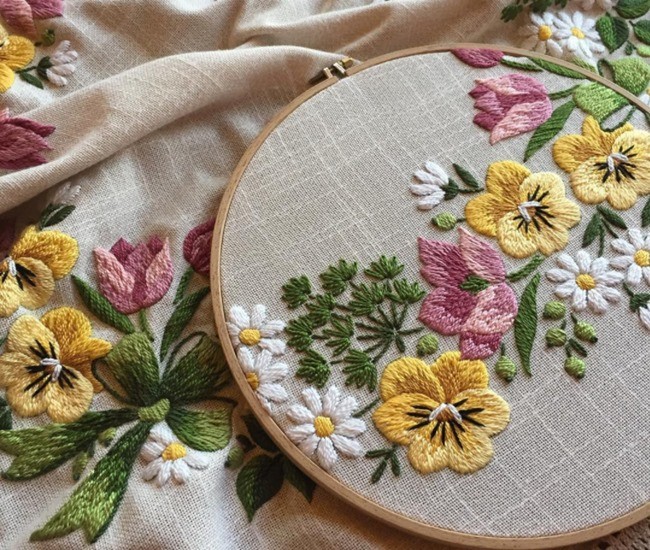
The craft website FreeHandmade.com offers beginners and experienced makers the opportunity to learn satin stitch embroidery at home through free video lessons. Additionally, you can download satin stitch embroidery patterns for free directly from our website.
Basic Stitches in Satin Stitch Embroidery
This technique includes different ways of making stitches.
- Stem stitch – perfect for depicting stems and outlining contours, resembling a small twisted cord.
- Running and backstitch – a universal option for outlining the grain contour of a sketch, serving as a kind of markup.
- Blanket/Buttonhole stitch – used for small elements, edgings, and finishing the raw edges of the fabric.
- Padded satin roll – used for finishing the edge of an item and adding volume to the design.
To begin, mastering one or two is enough. As you learn a larger number of techniques, you will be able to create much more diverse and interesting designs.
Additional Elements
There are common techniques for all types of embroidery that help add variety and realism to the work. To depict small bumps and tiny textured details, different types of knots are often used: French and bullion knots are the most popular. The chain stitch resembles a crocheted chain and is needed for straight and wavy thin lines. You can bring a picture to life by combining it with other types of crafts, embroidering with sequins or beads, or incorporating cross-stitching.
Flat Satin Stitch
Designs embroidered on various items differ in volume, color execution, and the character of the stitches. To obtain double-sided patterns, a technique with a mirror repetition of the front stitches on the reverse side is used. Straight or diagonal stitches are duplicated on the wrong side with the exact same neatness. This is equally applicable to wide and narrow elements.
Padded Satin Stitch
Need to get a convex, embossed pattern? Use the “padding” technique.
- Outline the contour of the future composition with a simple running or chain stitch.
- Lay the bottom layer of the satin stitch (the padding).
- Perform the top embroidery over the bottom layer, placing the stitches in the opposite direction to the bottom ones.
The padding can consist of several layers of thread of the same color, depending on the desired height of the element.
Couching Embroidery
Large areas can be filled with long stitches. To ensure a tight fit to the fabric, transverse securing stitches are made on top (at a right angle or diagonally). You can make securing stitches for each individual pass, or first fill all the necessary space with long stitches and then return to add the short securing stitches. This technique is well suited for large floral bouquets with big buds and inflorescences.
Thread Painting (Silk Shading)
Other names for this type of satin stitch include stroke and shadow stitch. It is a very interesting way to achieve designs with smooth color transitions. You need to divide the sketch transferred to the canvas into conditional transition boundaries and change the thread color in certain areas. The secret to smooth gradients is using stitches of different lengths, as if they are melting into each other. You will need to lay the stitches not exactly along the conditionally drawn boundary, but slightly higher and lower. Using this technique, you can create canvases on any theme, from full-fledged landscapes and still lifes to realistic portraits.
Vladimir Stitch (Surface Satin Stitch)
Laying the thread entirely on the top surface with only tiny dotted stitches catching the fabric on the wrong side is called one-sided (Vladimir) satin stitch. Unlike the flat double-sided stitch, it significantly saves embroidery floss. A striking feature of Vladimir embroidery is the red-blue-green color palette with vibrant splashes of yellow and orange. Another characteristic detail is applied grids or lattice work (mostly used for decorating flower centers). Popular motifs include birds and large flowers.
Richelieu Embroidery (Cutwork)
Cutwork satin stitch got its name from the famous historical figure, Cardinal Richelieu, thanks to whom this Italian technique gained immense popularity among French needleworkers. The embroidered fabric resembles lace due to the many cut-through openwork slots in the fabric. Most often, it is done with thread matching the tone of the canvas (such as white or beige). The main motifs are floristics and elegant abstractions. It usually decorates the corners and edges of tablecloths, napkins, handkerchiefs, and collars.
Suzhou Embroidery
Chinese double-sided silk embroidery is considered a highly refined traditional technique with a two-thousand-year history. The depicted subjects are wonderfully diverse, including the animal, plant, and underwater worlds. It is distinguished by a staggering wealth of shades (ranging from 80 to 1,000 in a single piece). Traditionally, threads are hand-dyed for each specific canvas. Translucent silk is used as the base fabric.
In ancient times, doing such crafts was considered an expensive luxury accessible only to aristocrats and wealthy ladies. Today, you can enjoy this creativity without much expense. It is enough to purchase multi-colored embroidery floss, needles, and an embroidery hoop (optional, used mainly for convenience). You can embroider on special canvas, your own clothes, or home textiles such as bed linen, table napkins, and tablecloths.


