Embroidery with satin and silk ribbons is an incredibly beautiful and fascinating hobby. Lovers of creating masterpieces with their own hands will definitely appreciate this type of needlework. It can be used to decorate clothes, bags, or to create stand-alone framed pictures.
This online selection of the best free video tutorials will give beginner crafters the opportunity to master the basics of ribbon embroidery and independently create their first beautiful compositions at home.
Materials and Tools
Before starting the embroidery process itself, it is worth preparing the necessary supplies used in the work. You need to acquire needles with large eyes (special embroidery or tapestry needles) through which the ribbons can pass freely. You will also need an embroidery hoop to stretch the fabric and make the work easier (ordinary round hoops or square snap frames).
The base material plays an important role in the future composition. It should not be too dense; it is best to choose gabardine, linen, or ready-made fabrics with a pre-printed composition. And most importantly, you need to choose the right ribbons, of which there are many. It is better for beginner embroiderers to use satin ribbons in the initial stages; after practicing, you can include organza and silk. You will also need fabric paints for tinting, a lighter or a candle (to seal the ribbon edges), scissors, fabric contours, modeling gel, a disappearing marker for drawing the pattern, and embroidery floss.
Ribbon Embroidery Techniques for Beginners
Armed with the necessary materials, you can begin to study the art of embroidery itself. This master class from Tatiana Shelipova’s Needlework School will be interesting for those who are just taking their first steps. She will show a proven technique for securing the ribbon on the fabric so that it doesn’t slip out. The master will demonstrate the basic stitches used to create leaves and flowers. There are several types of stitches and knots, and by mastering them, you can already embroider stunning elements.
Stem Stitch Rose: Master Class
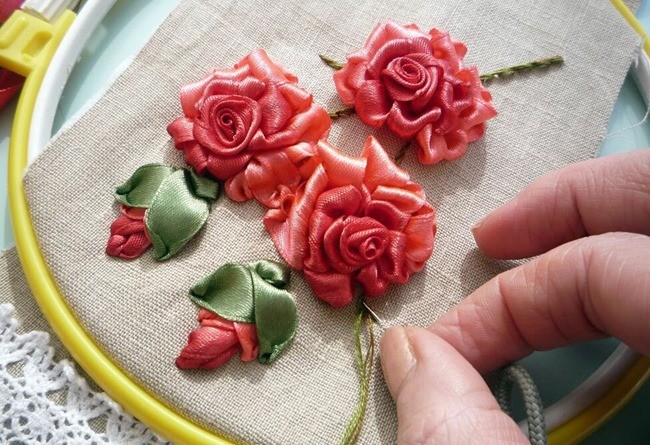
Roses are a staple in many floral bouquets, and there are different methods for creating them. The video presents a variant of creating a rose using a 6 mm ribbon in two colors. It is performed with a stem stitch and consists of two parts. First, a colonial knot is made, which will serve as the core. Petals are embroidered around it with separate stitches. The remaining rows are made in the same way, while the stitches are brought out in a checkerboard pattern, overlapping the middle of the petal of the previous row.
Bluebell: Step-by-Step Lesson
This delicate and beautiful flower will look great as a standalone picture, a decorative element, and it pairs perfectly with other flowers. The author of the lesson will show 3 simple ways to embroider bluebells. The first shows the process of creating a bud, using several techniques: a French knot, which gives volume to the flower at the base, and a straight stitch, which creates the petals and covers the knot. The second is a flower with stamens made using a French knot on a stem. The third option is a more complex, voluminous flower created by layering several rows of ribbons on top of each other.
Embroidering Lavender with Ribbons
Lavender is quite a simple flower to embroider. The video shows one of the easiest ways to execute it. For this work, you will need lavender and green colored ribbon (6 mm), a needle, suitable fabric, scissors, and a hoop. First of all, it is necessary to sketch out the future design. It is better to start embroidering with the stems, choosing one of the two demonstrated methods. After that, the flower itself and the leaves are embroidered with a regular straight stitch.
Miniature Floral Composition
This is a video master class on embroidering a small composition that will look great when decorating home textiles. It is made up of several types of flowers and herbs. The work is done in blue, red, and olive colors, with the addition of white yarn, threads, and beads. First, you need to draw a sketch of the future picture. Each element of the drawing is embroidered separately using various techniques. The author will explain in detail what techniques are appropriate to use and what effects can be achieved with them.
Voluminous Cornflowers
Cornflowers can be included in a mixed bouquet or made as a separate composition. For a bouquet of cornflowers, you will need ribbons in green, lilac, or purple of different shades, and threads for the center. This master class will help beginners master cornflower embroidery. It will be presented in 3 variations: fully open with stamens, turned to the side, and a closed bud. They are performed with a straight stitch, using ribbons of different tones to create a 3D volume. The stems are made using twisted ribbon, which is then sewn on with threads. The leaves are embroidered using any convenient method.
Garden Daisies (Chamomiles)
Daisies will perfectly decorate pillows and clothes, and they look highly advantageous on a colored background. This lesson from a master crafter is perfect for beginners with little experience to learn the technique of making this flower. White and green 6 mm ribbon, a piece of velvet for the middle, colored fabric, and acrylic paints for tinting are used. Everything is very simple: stitches are made from the center to the edge, and then from the edge to the center, where they are gathered more tightly. Then the actions are repeated in a circle. At the end, a core of velvet fabric is sewn on. To give the daisy a more realistic look, its petals can be slightly tinted with paint.
Ribbon Peonies
Peony flowers look stunning as an independent composition. The master class by Elena Kubrina on embroidering peonies consists of 3 parts: 1 — open peony, 2 — flower looking to the side, 3 — bud. After watching the entire video and repeating the actions step-by-step, you can get a beautiful finished work that only needs to be placed in a frame. Pink ribbons of 5, 10, 25, and 40 mm, along with a fairly dense base material, will be used.
Embroidering Roses with Ribbons
This embroidery lesson will present another variation of making a rose. By forming each petal separately and giving them beautiful curves, we get a fully voluminous flower. To work on creating such an element, you will need a 25 mm ribbon and matching threads. The detailed video will show all stages of work, from marking the sketch on the fabric base to the finished flower. The main thing is to have patience and not rush. Such a hobby does not tolerate haste but requires persistence and love for the craft.