Decorating with satin and silk ribbons is an ancient art that has become incredibly popular among modern crafters. This hobby requires no large financial investments and is perfectly suited for those looking to start making handmade crafts for the first time. With the help of decorative ribbons, you can create beautiful DIY ribbon flower compositions of varying complexity.
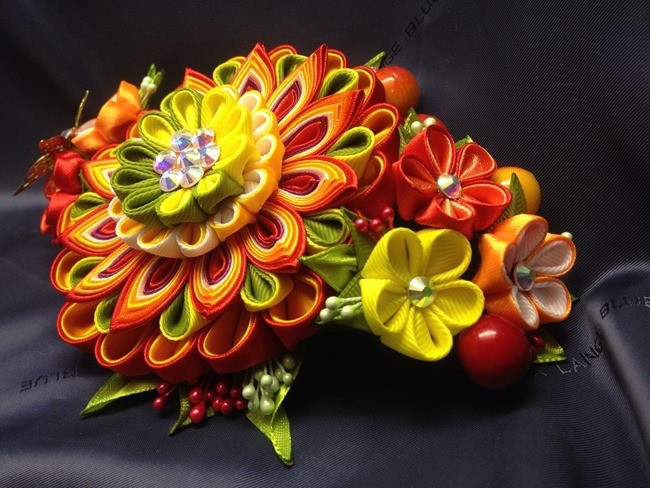
We invite beginner crafters to master the kanzashi technique right at home with the help of our step-by-step video tutorials.
History of the Kanzashi Technique
Traditional kanzashi is the Japanese art of decorating hair with handmade flowers. Meanwhile, silk ribbon crafts gained global popularity thanks to the French kings Louis XIV and Louis XV. The former encouraged decorating all clothing items with ribbons, while the latter was fond of needlework himself. The trend was later picked up by the first-ever haute couture designer, Charles Worth, who initiated the trend of decorating lingerie and accessories (umbrellas, shoes, fans, and gloves). In monarchial times, ribbon appliqués were complemented with pearls, gold, silver, stones, and crystals, emphasizing high birth and financial prosperity. Today, this hobby is accessible to every crafter: the tools and consumable materials are very inexpensive, especially when ordered online.
Essential Materials
The primary task of a beginner crafter is to learn how to navigate the types of ribbons and choose the right tools. For ribbons, there are four standard widths (3mm, 6mm, 12mm, 24mm) and two quality variations (soft and stiff). The second requirement is to choose two pairs of tweezers: a curved one for shaping petals and a straight one for working with small details and hardware. For the base, it is best to use felt fabric cut into small circles. Additionally, you will need scissors, a hot glue gun, a ruler, and a lighter or a burner. Rhinestones, beads, lace, and braid can be used for extra decoration.
Basic Safety and Workspace Rules
Simple rules will help make your work comfortable, safe, and save you valuable time:
- When using a soldering iron or hot glue gun, always place the hot tool on a special stand.
- Keep candles and burners away from your ribbons and other flammable materials.
- Maintain order on your desktop: only the necessary items should be at hand, and everything else should be stored in a drawer or a general craft box.
- Prepare materials for work in advance, iron the fabrics if needed, and lay them out neatly in front of you.
- Use a good desk lamp for better lighting and precision.
Features of the Kanzashi Technique
The kanzashi technique consists of combining various types of elements into a single composition. The vast majority of designs are based on floral motifs: buds, blossoms, leaves, stems, and grass. To recreate flowers, crafters use a simple folding method of fabric squares, as well as more complex and unique techniques that border on origami and weaving. Experienced crafters use a maximum of diverse elements in one bouquet, achieving greater volume, texture, and realism.
Kanzashi Petals
These parts are suitable for small floral elements (petals, leaves, stems, and grass). There are two foundational types: sharp petals and round petals. Everything else is a variation and a flight of your imagination. For your first crafts, it is enough to master a few of the most elementary types, without curls, tacks, or zigzags. These starter techniques will allow you to create professional-looking bouquets of daisies, calendula, and peonies. Once you master simple petals, you can move on to trickier ones: twisted, entwined, curved, multicolored, and multi-layered petals.
Basting and Gathering
This is the ideal option for a beginner to get beautiful florals with minimal effort, a technique borrowed from embroidery. Basting works on the principle of appliqué: the finished decor is sewn onto the fabric. You can make a blank in a matter of seconds. The ribbon is stitched and pulled tight in various ways, resulting in full-fledged buds—a technique so easy even a child can handle it. The center of the gathered flower is usually decorated with a core made of beads, knots, or thread stamens.
Ribbon Knots
Knots are easy elements for decorating hair ties, clips, headbands, bags, hats, and shoes. They are also excellent for filling empty space within or around a bouquet. Depending on the desired size and effect, they can be made with ribbons of different widths. Often, the knotting method is used to compose complex inflorescences, fluttering butterflies, or decorative bows.
Making Buds
This element is mainly used for roses (both closed and blooming), poppies, rosehips, tulips, water lilies, and peonies. There are many ways to make them: twisting a solid piece of ribbon, assembling them from folded squares, or putting together pieces that are cut into petal shapes and singed at the edges. By learning how to make different types of petals, you can achieve an almost infinite number of bud designs.
Assembly and Design Options
Following historical examples, modern crafters decorate clothing, accessories, and interior items with their ribbon creations. When decorated with floral compositions, ordinary blouses, dresses, and shirts transform into designer pieces. Ribbon bouquets look highly original in jewelry, such as brooches, bracelets, and lockets. Pillows, paintings, tablecloths, and curtains decorated in the kanzashi technique will harmoniously blend into any interior design.
Kanzashi Ribbon Paintings
Unlike photography, ribbon paintings usually have two planes: the foreground and the background (without a middle ground)—meaning the main image and the backdrop. Professionals use a simple trick to give the artwork depth: tinting. A simple application of monochromatic paint can create the impression of masterful execution. If desired, you can draw the composition completely down to the smallest detail. Pros suggest using watercolors, crayons, or watercolor pencils. To draw the future pattern, it is convenient to use special fabric markers that disappear after two days or when sprayed with water.
You will never run out of ideas for your ribbon masterpieces: the internet is full of step-by-step schemes and photo examples. By developing your aesthetic taste, you can eventually start creating your own exclusive kanzashi designs.