Polymer clay allows you to create miniature items mimicking animals, people, berries, and fruits using the classic principles of shaping forms from pliable materials like wax, clay, and gypsum. However, their application is much broader, ranging from women’s jewelry to interior figurines. You should start learning with simple crafts consisting of a few colors and details, and then move on to experimenting with color, fine details, and painting.
FreeHandmade.com has selected the best video tutorials on working with polymer clay for beginners.
Preparation
https://youtube.com/watch?v=Kzz1Zh20NW
One of the advantages of polymer clay crafting is its affordability. The largest expense will be the modeling material and liquid clay. Most tools can initially be replaced with household items – toothpicks (for piercing holes), an old marker (for rolling), and a toothbrush (for creating a rough texture). Here you will find out what you absolutely need to buy, what is optional, and what you can save money on.
A master class for beginners – a simple, cute two-color cake (white and purple in the example). This will help you decide if you want to continue with this hobby. You will need a minimum of tools (a brush, a knife, round cookie cutters, a rolling pin, and eye pins for later attachment), materials, time, and effort. In total, you get 8 cake slices, which can be used to make earrings or a keychain.
Flower for a Pendant
Elena Marunich – a designer of exclusive jewelry and author of books on polymer clay modeling – will show you how to make a flower for a stylish pendant. You will need material in three colors – white, lilac, and green. Petals are formed from the lilac and white clay, while the sepals and stem are made from the green. It is recommended to knead the material with your hands to make it softer and more pliable. At the end, Elena will demonstrate the technique of assembling a necklace on a special jewelry wire.
Citrus Canes
These are cylindrical blanks in the shape of a lemon, which can later be sliced into circles and used as separate decorations or to decorate imitation confectionery. The instructor details the process of creating these canes using three colors – intense yellow (zest), translucent yellow (slices in cross-section), and light gray (the layer between the slices and zest). Using this technique, you can make canes for any citrus fruit – lemon, orange, grapefruit, or lime. The diameter of the cylinders can be adjusted as needed. It is recommended to store them by dividing them into two parts: one part is baked and ready to use, while the other is left raw (so adjustments can be made).
Polymer Clay Raspberries
https://youtube.com/watch?v=mfQpOJgzmfQ
An appetizing raspberry, visually as close to the original as possible, is perfect for making earrings, a pendant, or a keychain. Making the berries is not difficult, but attaching the small elements requires patience. The item is baked in two stages: first, the core (onto which the small berry balls and the green part are later attached), and then the finished berry. How realistic the raspberry will look depends on the choice of color. It is recommended to bake samples of different shades to see which looks the most natural.
Mug Decoration: Little Girl
https://youtube.com/watch?v=a9qCc-hwPwQ
The video shows how to decorate a mug with a 3D applique of a girl. This tutorial is suitable for crafters with some experience who know how to use the basic tools. The girl is made of many details, some of which are quite small. This craft requires time, perseverance, and at least a minimum of practice. Beginners can use this master class to practice their tool skills and ability to form fine details.
Mug Decoration: Bunny
Using this video tutorial, you can create a bunny decoration for a mug. The lecture is intended for people with experience working with polymer clay. The information is presented concisely: clear visuals with text comments. Beginners will learn how to create imitation fur with a needle, a “knitted” hat by twisting thin pieces of material, and highlights in the eyes using tiny white balls. Finally, the process of gluing the little bunny onto the mug is demonstrated.
Rose – Simple Version
Rusalina is a master of making polymer clay jewelry. This master class is dedicated to creating a rose using a highly simplified technique. Rusalina will show you how to form dozens of petals with a textured surface on both sides in just 1 minute, create a smooth color gradient, and assemble the blossom so that the color transition is beautifully preserved. In the final part of the video, Rusalina demonstrates the process of assembling a pendant with the newly made rose. The item is baked in 2 stages – first the attached petals, and then again with the fixed sepals and the metal hanging element.
Polymer Clay Feathers
A tutorial on making feathers for a brooch. The sequence of actions is demonstrated in detail, although there are no author’s comments. It is perfectly suitable for crafters with minimal experience. You will need black clay, pigment powder for shading, varnish for the final coating, a blade, and a needle to apply the texture.
Peony Earrings
You can make miniature replicas of peonies, which can then be used to create earrings and necklaces. You will need a lot of time and patience for this work – each petal and leaf must be shaped individually. The author shows how to make petals, form buds, half-blooming, and fully blooming flowers, secure the sepals, and attach the entire composition to the earring base.
DIY Apple Modeling
This detailed video clip will allow even beginners to make a luscious little apple. For this project, you will need white and green clay, pastels for tinting, and varnish for the topcoat. The instructor makes 3 items, from which she forms a pendant and earrings at the end of the video. The technique is simple enough for any beginner to replicate. Thanks to the varnish coating, the apples take on a highly natural appearance, the surface starts to reflect light, and proper blending of the pastel powder helps create a realistic, gradient color.
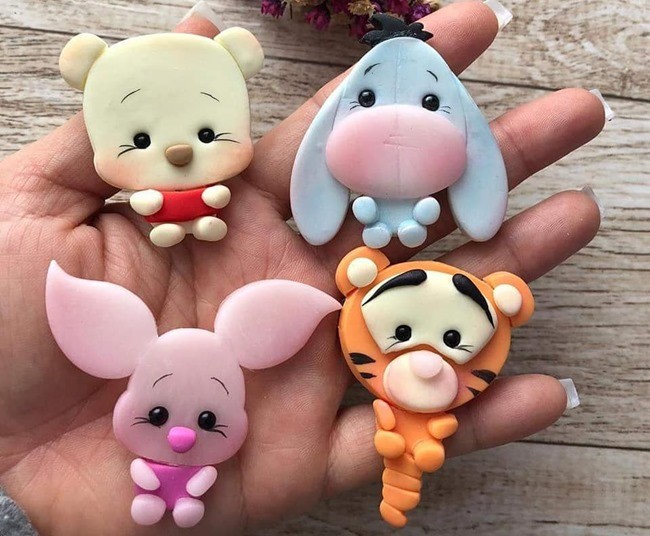
Using these skills, you can invent and realize your own unique compositions from real flowers, vegetables, berries, cartoon characters, or animals.