Making a DIY hammock is entirely realistic; the main thing is to choose the right model. If you do not have needlework experience, you should opt for simple variations where you only need to connect a durable fabric bed with a suspension cord. To prevent the hammock from rolling up, wooden spreader bars are used. More complex options include woven models, hammock swing chairs, hammocks with stands, and those upgraded with additional accessories.
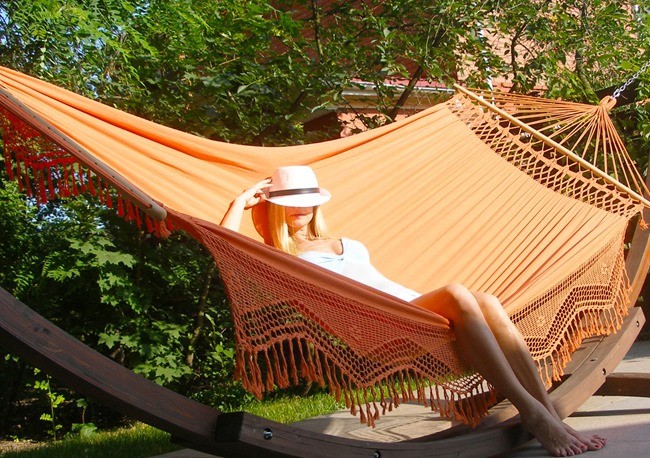
We have selected the best free master classes and video tutorials that will help you make a hammock yourself at home.
Simple Garden Hammock on Two Spreader Bars
Even someone who has never held sewing supplies can make this easy-to-use, simple-to-craft, and budget-friendly hammock. To make it, you will need durable fabric, two medium-thickness wooden sticks (the author uses shovel handles, which can be easily bought at a hardware store), a clothesline, and a very strong thread with a needle. A drill is handy for making holes to thread the suspension cords. If you use brightly colored elements, the finished product will look much more aesthetic.
Advanced Model with Two Spreader Bars
This build will take some time, but the resulting product can easily rival store-bought ones in both quality and appearance. You will need: a piece of fabric for the main bed (calculated so it can be folded into three layers) and a piece for the straps, a clothesline, heavy-duty denim thread, and two wooden poles. The tools used include a drill (for holes in the wooden elements) and a sewing machine (to hem the edges and attach the straps). Pieces of cord are fixed along the entire length of the pole at equal distances and woven together, forming something like a large net. Everything is done simply; anyone can repeat after the author. You can use the leftover fabric scraps to sew a small pillow and a pouch for a book or tablet.
DIY Hammock Swing Chair
A round hammock for a garden recreation area. You will need fabric, a hula hoop for the frame, foam rubber, a sturdy strap, and about an hour of your time. This swing will appeal to both children and adults; the only difference is the hanging height. The seat size depends on the hoop’s diameter. Based on this technology, you can easily make a hammock chair of any size.
Hammock with a Wooden Suspension Stand
A video tutorial on making a hammock and a wooden suspension stand. The hammock itself is made of fabric and rope—one of the simplest models. For the stand, you will need six 100×100 mm wooden beams and strong fasteners. The structure is notably reliable and easy to build. The author explains all assembly steps using an already finished product. The stand turns out massive and stable; it can even be left in the garden over the winter.
Hammock in 10 Minutes
Sergey Fedoseev shows how to make a quick hammock in 10 minutes using lining fabric and two regular carabiners. You need to gather the narrow part of the fabric piece like an accordion, hook it onto the carabiner, and carefully secure it with a strong cord by tying several tight knots. This product will be a great find for hiking and camping enthusiasts—its weight, including metal elements, is only 300 grams. If desired, you can replace the carabiners with strong rope loops and choose a denser fabric.
DIY Woven Hammock
For this project, you will need a strong rope, two wooden slats with holes for the rope to pass through, and a little time. Olga demonstrates the sequence of actions and the knot-tying technology in detail. This is a classic woven model, and making it yourself will be 2–3 times cheaper than buying the exact same one from a store. The color of the hammock and the length of the bed can be adjusted as needed. The video is shot in the style of an entertaining show—it is not only useful but also fun to watch.
Professional Manufacturing Method
All stages are shown in such detail that anyone into needlework can easily repeat the steps. The result: a wide woven hammock on two spreader bars, made professionally. The bed is woven from a continuous cord rather than separate cut pieces, as is often done at home, so a large shuttle will be very useful for the job. Thanks to this technology, there are no knots on the bed itself—the net turns out soft and elastic, allowing you to lie comfortably without needing to lay down soft fabric to prevent knots from digging into your back.
Transformer Camping Hammock
A comprehensive video instruction on creating a transformer camping hammock, which requires only a piece of strong fabric and a durable rope. It takes just a couple of minutes to set up. The author shows in detail the technology for tying knots that will not stretch or loosen during use but can be untied in a single motion. Additionally, the author explains how to make a backrest for comfortable sitting, turn the product into a kind of swing, and tension the corners so the structure securely wraps around a sleeping person on the sides.
DIY Net Hammock
The simplest option for placing in the garden or relaxing in nature. You will need two wooden bars with holes, a cord divided into segments of the required length, and a sturdy metal ring for hanging. The weaving is done by tying knots, and the mesh bed consists of diamond-shaped cells. This video instruction has no commentary—the clear, detailed sequence of actions will appeal to anyone who prefers concise information. The explanatory titles are in English, but the process is so simple that it is perfectly understandable without knowing the language.
Round Hanging Model
To make a hanging round hammock, as shown in this master class, you will need a large-diameter hoop and a strong cord. The cord is cut into pieces and fixed on one side of the hoop, then the ropes are woven using macrame techniques to form even cells. The suspension straps are made from the same material. To keep the ends from unraveling, they must be melted with a lighter. The result is a beautiful, elegant product that can withstand heavy loads (the author’s design is rated for up to 400 kg).
For the bed, you can choose synthetic or natural fabric. Natural fabrics are hypoallergenic, highly breathable, pleasant to the touch, and absorb moisture well. Their disadvantages include a shorter lifespan—the material stretches quickly, loses its shape, wears out, and tears. Synthetics might not be the most natural choice, but they can withstand heavy loads, retain their original qualities longer, do not absorb moisture, and boast a very long service life. For a garden hammock, natural materials are highly recommended, while synthetic fabrics are better suited for fishermen, hunters, and campers.