Cross-stitching is the most famous and one of the oldest types of needlework. In the old days, beautiful patterns were born without templates, right during the work process. Today, the endless variety of shapes and colors in embroidery pleases the eye and attracts many to this wonderful craft.

We have selected the best free video tutorials on cross-stitching for learning at home, which will be incredibly helpful for beginner embroiderers.
Cross Stitch Materials
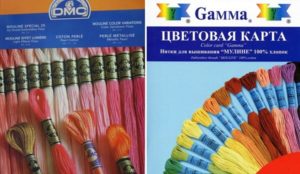
The result of any embroidery primarily depends on the right choice of threads: thick threads for stitching on rough, heavy fabrics, and thin threads for more delicate work. For the canvas base, it is best to use:
- fabrics with a surface where squares are clearly visible (even-weave fibers or a small checkered print);
- machine or hand-woven linen fabric;
- fabrics with a loose weave;
- cotton Aida cloth or canvas (perfect for table linens and framed pictures);
- thin sheer fabrics.
Getting Started
Before starting, you should not tie a knot at the end of your working thread (it can easily slip through to the front side). Most often, a thread tail of a few millimeters is left on the wrong side (back) and stitched over to secure it as you work. Transition threads (jumps) between pattern details should be as short as possible (especially when working with multiple colors). If a short jump is impossible, it is better to cut the embroidery floss and secure the end under the existing stitches on the back. Start the next section with a new thread.
Each standard cross stitch consists of two intersecting stitches (a bottom arm and a top arm). Horizontal rows are done in two steps: first, the bottom row of half-stitches from left to right, then the top half-stitches from right to left, inserting the needle into the same holes of the first row. Vertical lines will form on the back side. When making vertical and diagonal chains, each cross is completed fully before moving sequentially to the next one. The same applies to elements spaced far apart.
Bulgarian Cross Stitch (Leviathan Stitch)
This consists of two crosses superimposed on each other at an angle: a diagonal one and a straight one. The main rule: the number of fabric threads in height and width must be even. When embroidering a row, you completely finish one cross before moving to the next. You can use any traditional pattern for this. It is recommended to use thick threads so that the fabric does not show through. It is better to choose woven bases with a clearly distinguishable texture. These ornaments are great for decorating throw pillows and creating background compositions.
Two-Sided Star Stitch
It looks similar to the previous element but is executed differently. All stitches converge in the center and look identical on both sides. In rows, you first embroider half of the stars, then fill in the second halves on the way back. Transitions between rows are made on the right side of the design. If the chains are of different lengths, the thread is passed under the stitches on the wrong side. When the distance between elements is relatively large, it is better to start each with a new thread, hiding the end of the old one under the finished ornament.
Smyrna Cross Stitch
https://youtube.com/watch?v=axRyJTeKu2I
These are diagonal stitches that face different directions in each adjacent row. It is usually done on canvas with thick wool or cotton threads. The space between the stitches, laid in dense strips, should not show through. It is often used for decorating wall rugs. Individual fragments of Smyrna ornaments are sometimes bordered with diagonal contrasting stitches.
Half Cross Stitch (Tent Stitch)
A variation of the cross stitch where adjacent tracks lie parallel. It is ideal for solid, filled designs. It is important to stretch the fabric tightly in an embroidery hoop to prevent the canvas and the resulting pattern from warping. Details can be bordered with straight or diagonal stitches for greater clarity and expressiveness.
Holbein Stitch (Double Running Stitch)
Used for patterns consisting of straight and curved lines. It looks identical on both sides of the canvas. You can make straight, diagonal, zigzag lines, and branches. First, you make a line of running stitches, then in the opposite direction, you fill in the gaps. In the second stage, the needle should be inserted over the right end of the previous stitch and brought out under the left. This creates a twisted cord effect.
Renaissance Stitch
Known since the Renaissance, it has survived to our time due to its simplicity. It is intended for dense mosaic patterns. It consists of long stitches intersected in the middle by short transverse ones. The long ones can be strictly vertical, diagonal, or curved. You can use classic patterns where each standard cross stitch will correspond to three “Renaissance” stitches.
Gobelin Stitch
Consists of small slanted and vertical stitches that are applied densely or at a distance from each other. The working direction is always one-way, from left to right. A typical feature when transitioning between rows is that the thread is laid from the end of the previous one to the beginning of the next, and then covered with stitches. Wool, cotton, or silk threads are usually used. The resulting patterns resemble antique woven tapestries in structure.
Herringbone Stitch (Velvet Stitch)
Another common name for this is the “goat” stitch (Herringbone stitch). The most popular varieties are: figure-eight, one-sided braid (Slavic or Hungarian braid), and double herringbone. When using standard patterns, keep in mind: each figure of the one-sided braid is twice as large as a single cross stitch in height and width, so the entire design will turn out twice as large.
Embroidery techniques are incredibly diverse. By mastering these methods, every crafter can use this skill in everyday life: to elegantly decorate clothing, interior textiles, and bed or table linens, making items look much more festive and unique.